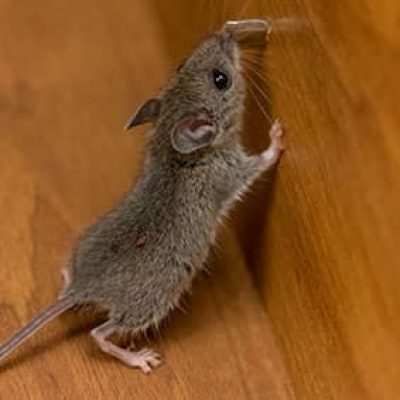
The house mouse is an allusive rodent which commonly lives near humans scavenging for food and materials to build their nests.
Identify
The head and body of an adult is about 65 – 90 mm long.
The tail is equal to or a little bit longer than the body of the mouse.
They have large rounded prominent ears, pointy snout and a long hairy tail.
Habitat & Life Cycle
Of the most common rodents found in homes and there where humans dwell. These rodents can sneak in through an open door or openings in walls and plumbing. One can find them nesting in the roof, storage areas and in grass fields.
How to Spot Them?
Gnawing on stored foods and droppings are your first signs.
The droppings are 3 mm long and pointed with small ends.
The house mouse’s dropping are noticeably smaller to other rodent droppings.
Brown Rat
Rattus Norvegicus
The brown rat has many names such as sewer rat, street rat, Norway rat and the Norwegian rat.
Identify
The head and body of an adult is about 180 – 255 mm long.
The tail is longer than the entire body.
Uniformly coloured from top to bottom.
Large prominent ears that stands out from the fur.
Habitat & Life Cycle
Much larger than your house mouse. They can be found living in drains, thick vegetation, package and storage areas.
How to Spot Them?
Scratching gnawing sounds coming from the roof at night?
These rodents also tend to leave an oily stain along walkways, walls and skirtings.
Dropping are 12 – 13 mm long, elongated and have pointed ends. Noticeably similar to mouse dropping but much larger.
Field Mouse
Apodemus Sylvaticus
Also known as the wood mouse, they live outdoors creating extensive burrows in the soil.
Identify
The head and body of an adult is about 80 – 100mm long.
Brown orange fur over its entire body but for its white paws.
Some species are has grey fur with grey-white lines across the body.
Habitat & Life Cycle
Wood mice inhabit forests, grasslands, and cultivated fields, tending to seek out more wooded areas in winter. These rodents have a breeding season between February and October. The female gestates 25–26 days producing five young on average.
How to Spot Them?
Field mice create extensive burrows in grass, fields and any open land. Small patches of dug up soil near the roots of grass and other plants.